

Operatoric Research Corpus
Studies in World-Formation
Section II
Morphology and World-Formation
Volume 5
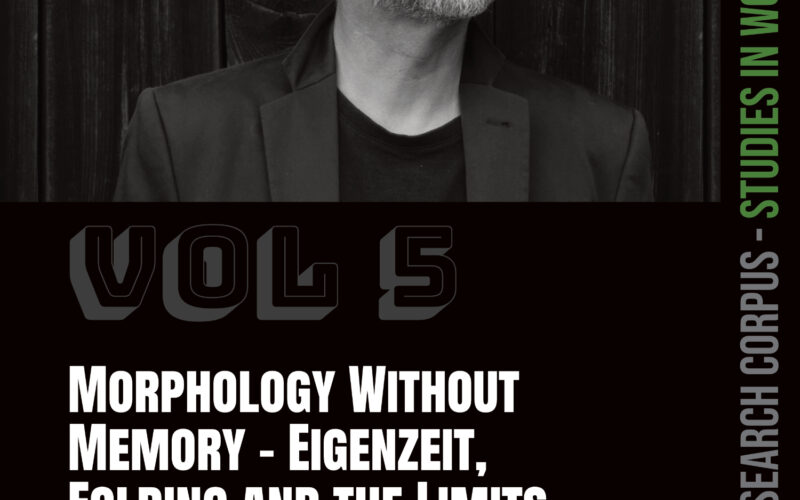
Morphology Without Memory – Eigenzeit, Folding and the Limits of Simulation
The present volume brings together six contributions that pursue a common question: under what conditions stable forms arise in natural, biological, social, and cognitive systems, and where the ontological limits of their reconstruction, control, or simulation lie. The point of departure is the observation that central contemporary debates—such as those in morphogenesis, complexity research, medicine, or artificial intelligence—are increasingly structured by concepts that treat form as in principle reconstructible: as a target state, attractor, setpoint, or as information within a state space. The volume systematically questions this implicit assumption.
The contributions develop a morphological perspective in which form is not understood as a stored structure or a retrievable goal, but as a temporary stabilization within irreversible dynamic processes. Earlier theoretical concepts such as focal points (Fixpunkte), folding, and the Bran-Spiral are genealogically reconstructed and related to later operatorial concepts such as shift of being (Seinsverschiebung), negative topology, and indimergent stabilization. From this perspective, form appears neither as the product of a plan nor as the result of linear processes, but as an emergent configuration that can stabilize only under specific historical and temporal conditions.
Against this background, central phenomena of biological morphogenesis are reread. Bioelectric regulation, regeneration, aging, cancer, or cloning no longer appear primarily as problems of genetic control or technical manipulation, but as boundary cases of emergent order. Particular emphasis is placed on the role of the Eigenzeit of living systems: the irreversible emergence-time in which form becomes genealogically stabilized. Interventions that attempt to bypass or neutralize this Eigenzeit therefore do not necessarily produce a return to earlier states, but rather temporarily stable yet ontologically displaced orders.
At the same time, the contributions show that many contemporary hopes for technical reconstruction—such as those found in regenerative medicine, bioengineering, or AI-based simulations—rest on a categorical confusion. Simulation operates within given state spaces and can reproduce formal stabilizations without participating in the ontological conditions of world-formation. Morphology, simulation, and repair must therefore be understood as three fundamentally different modes.
In the final step, this perspective is extended to a more general ontological level. If time itself is understood as the trace of irreversible loss of possibility, every stabilized world-form proves to be structurally finite. Indimergence appears here as a double boundary operation: it grounds world-time while simultaneously carrying the condition of its exhaustion. The volume therefore does not present itself as a complete theory of morphology, but as a precise boundary determination with respect to ontologies that assume the complete availability of form, information, and world.
Download PDF: https://zenodo.org/records/18996583
Speed, T. (2026). Morphology Without Memory – Eigenzeit, Folding and the Limits of Simulation (Studies in World-Formation, Vol. 5) (Version 1) [Computer software]. Zenodo. https://doi.org/10.5281/zenodo.18996583