




Operatoric Research Corpus
Studies in World-Formation
Section IV
Neurodivergent Epistemology
Volume 7
Autistic Ontology & Operator Architecture
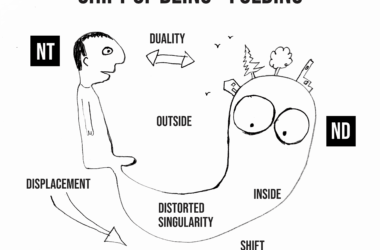
This volume brings together four contributions that address a shared question: under which ontological and epistemic conditions do different forms of human world-constitution arise, and what role does neurodivergent cognition play within this process. The point of departure is the observation that contemporary autism research largely operates under an implicit assumption: that all humans inhabit the same ontological ground and that differences appear primarily at the level of cognitive traits, information processing, or social abilities.
The contributions collected here systematically question this assumption. They develop the thesis that autistic and neurotypical modes of world-constitution are grounded in different operator logics. From this perspective, autistic cognition does not appear as a variation within a shared ontology but as a distinct epistemic position characterized by increased access to non-integrated structural relations of reality.
On this basis, several theoretical steps are developed. First, the concept of autistic ontology shows that differences between autistic and neurotypical subjects are not primarily communicative or cognitive deviations but arise from divergent modes of world-stabilization. Second, the Rosetta Operator formulates an invariant operator system describing processes of difference, tension, indimergence, and emergence as fundamental structures of reality formation. This framework connects multiple domains—including consciousness research, economic theory, and neurodivergence—within a common structural model.
Third, the concept of operatoric cognition introduces a non-representational form of intelligent world-relation that operates not primarily through symbols or meanings but through dynamic transitions, topological tensions, and emergent processes of form generation. Finally, the concept of veridical mapping is interpreted as an epistemic consequence of this architecture: an access to pre-symbolic structural relations that remains more directly available in certain neurodivergent cognitive configurations than in neurotypical forms of perception stabilized early through symbolic integration.
The volume thus proposes a shift in the theoretical framing of neurodivergent cognition. Instead of describing autism through deficit-oriented accounts of individual traits, it interprets autistic cognition as an epistemic boundary position within the open process of world-stabilization. In this perspective, autism becomes relevant not only for cognitive science but also for epistemology and the philosophy of science, as it reveals alternative modes of world-access that challenge representational models of knowledge.
The concepts developed in this volume are not presented as a final theory but as a structural framework intended to integrate previously fragmented models of autism research while opening a broader perspective on the conditions of knowledge, perception, and reality formation.
Download PDF: https://zenodo.org/records/18997742
Speed, T. (2026). Autistic Ontology & Operator Architecture (Studies in World-Formation, Vol. 7) (Version 1) [Computer software]. Zenodo. https://doi.org/10.5281/zenodo.18997742