



Over decades of research (Artistic Research), in view of the crises of recent years, I tried to explore the question of which work (as the dominant form of human action) is adequate today and how value of work and contribution should be understood in an ecological and sustainable sense.
In doing so, it became clear — which is not new in itself — that “jobs” in their external determination (Marx), in the “iron cage” (Weber), too often lead to opportunistic behaviour and have negative effects on solidarity and authentic responsibility, that is, on the important building blocks of humane and innovative, creative collaboration.
As a result, less and less work was being done on the “actual problem questions” in terms of the bigger picture (ecology, economy, social) of society as a whole. Responsibility shifted into pure obedience to the market, in order to earn money, in order not to be a burden to anyone, while exactly that in the end burdened everyone psychologically, ecologically and economically. A consequence of the private-sector division of labour.
Because a way of working that partially or entirely reintegrates the bigger picture would be a lengthy and hardly payable form of work via wages — and still is — a solution seemed far away. It was about an approach of democratisation of work (Axel Honneth), thus of the democratisation of capitalism itself (Thomas Piketty).
What we perhaps need today is not compatible with a labour market based on efficiency alone. Jobs narrow the human being.
Although these investigations were, as already mentioned, also about familiar phenomena such as alienation according to Marx, or bullshit jobs according to David Graeber, or approaches such as “New Work” (Frithjof Bergmann), I tried beyond that to find out how it can be done differently when one intervenes in systems oneself. Much could not be generalised or, as in the case of “New Work”, was simply absorbed by capitalism.
Because the classical approaches describe the picture from the outside, these researchers generally did not try to radically transform their own way of working. They were or are academics in professor jobs.
In countless empirical experiments with companies and state institutions, through provocation and intervention, I investigated how institutions behave when actual people attempt to bring individual wishes, insights, identifications of problems or crises into them, to make them part of the work. This taking possession of work, by the person who becomes responsible, became the basis for the development of new rules or frameworks in which another form of working — work as work on the world, on society — began to reshape capitalism and patriarchy, at least in the experiment. One could understand it as an attempt to expand capitalism. By connecting the private-sector sphere with the individual and the whole societal and ecological sphere. However, much more radical than in the sense of buzzwords like sustainability or in attributions assigned to the work attitude of the “revolutionary” generation X, Y or Z. Also different from what happens in many companies, simply a bit of greenwashing here, a bit of social work-life balance there, or the seeming integration of “New Work” as long as it does not hurt — I placed the emphasis on an integration from below, that is, through the subjectively experiencing individual. Through the non-conforming human being who intervenes critically. Only here the concrete became visible.
Only when one tried, radically, to perform the actually appropriate work, in subjective and entirely individual response — because only the individual recognises problems — when one did not ignore the problem fields of this society or gloss over them in marketing, did and does it become apparent how primitive, how incapable and damaging the capitalist market actually is in its countless reductions. How one-sided assignment of value leads to massive destruction. How exclusion and exploitation unfold.
The only lever that humans still have today against capitalism is the overcoming of the fear of poverty and of the associated stigmatisation.
Here the advantage of the research approach in Artistic Research became visible, in which the individual, as the trigger of the experimental setup, is part of the experiment. In this way art, activism and research could be combined.
I entered companies and authorities and began to reshape them, to provoke, to advise, to inspire or to frighten. Disruption and reintegration of experience became the tool for exploring new approaches to work. The often financial consequences were placed before society for discussion, in the sense of: “Would you rather that I sell gummy bears, or how are you now going to deal with the work I am doing?”
One can develop long theories on this, which I also did, but it was especially important to me, in practical empirical experiments such as the “Radical Worker”, to make the friction surfaces visible and to show how it could be done differently. In doing so, what emerged was not the usual socialist visions, but an attitude in which the focus was on upgrading the individual as such — but not as a preformatted pseudo-diversity of a consumer in the free market, but as an authentically developed deviation which, in the multitude, implied more complex and therefore actually freer economic structures and societies, or at least made a path towards them visible. Because the foundation of freedom is always a diverse basic structure. The more complex, the more liberal, the more fear is removed from the system — which has become a considerable problem today, as complexity is not answered with more freedom but with more simplification.
The critical consumer is fundamentally too weak; only the critical worker or employee, or entrepreneur, who takes possession of the job in the name of humanity, is capable of lifting the force necessary to change the economic and ecological conditions of our time out of the ground.
Here you will find a compilation of individual terms and concepts that have emerged in the course of this 30-year work. More about this can also be found in my books.
Theories and terms from the work between 2001 and 2024.
Submergence is a fundamental problem of our time. The concept makes it understandable how phenomena such as fake news, globalisation, simplification, or the decay of solidarity and of deeper relationships in social structures emerge and take effect.
Submergence describes a state in which the ability to distinguish is lost because systems or structures become so strongly unified that creative and dynamic forces weaken. This lack of creativity and development is directly linked to a static definition of reality, because the perception of reality becomes flat and superficial.
In the process of emergence, submergence leads to an isolation of the system, which prevents it from recognising complex external influences. This results in a dissolution of social structures, economic crises, and an increasing decay of intelligence in leadership levels.
The solution to this condition lies in the revitalisation of the system through the establishment of relationships and experiences that deviate from the norm — a challenge to submergence through individual and divergent perceptions. In an economic context, this means moving away from mass products and promoting diversified, ecologically integrative structures.
The contemporary relevance of the concept of submergence can be seen in various social areas. For example, the state of submergence in politics contributes to a weakening of the experience of reality and supports the rise of populism, which relies on simplification and the separation of indimergence — the blocked uniformity of objects. In the economy, submergence, through standardisation and objectification, reinforces the tendency toward monopolism and undermines the vitality of economic ecosystems.
To counteract the flattening of problem-solving capacities, the shift to the right, simplification, and the spread of fake news, a political and economic departure from constant submergence-striving would be necessary. This includes embodying genuine diversity, enabling divergent experiences, and abandoning a purely objectivity-based understanding of reality. It also requires that individuals and societies detach themselves from rigid constructions and engage in living relationships in order to reactivate creative and dynamic potential.
Timothy Speed considers the Universal Basic Income (UBI) against the background of exploitation in capitalism and links it to questions of economic value creation and social integration. Speed explains that the UBI does not necessarily solve the problem of exploitation, because the dependence on high growth remains in order to finance it, if there is no homogenisation of value distribution, meaning a solution to massive inequality. The UBI could therefore merely mean a shift of exploitation. Speed understands the UBI as a possible answer to the challenges of a society oriented toward efficiency increase and simplification, with the aim of stopping the destruction of diversity and strengthening economic competence also among the poor.
Speed sees the UBI, however, initially as a transition to a transformed economy that understands value in a broader sense, that is, to a comprehensive upgrading of the human being, and thus to the integration of previously unseen forms of contribution that are too little or not honoured.
He thus demands an economy that is more comprehensive and more diverse and places the human being and his complexity at the centre, instead of adapting him to the requirements of the market and productivity thinking. His particular view of the UBI is therefore characterised by a creative and integrative emphasis on individuality and social justice, which can form a basis for new forms of value creation and social cohesion.
Speed emphasises, however, that a UBI alone does not solve the fundamental problems, but that we must fundamentally achieve an upgrading that enables high internal diversity of an economy as an ecosystem, removes existential fear from the system and promotes cooperation and the capacity for relationships. Because a UBI could otherwise also become the storage room for entire social groups.
The concept of the oppositional social system, as presented by Timothy Speed, stands in contrast to conventional social systems such as, for example, a citizen’s income. Speed sees the problem that existing social systems conceal the complex causes of poverty through simplification and stereotyping, and that the revolutionary and innovative force contained in the experience of poverty — that is, the knowledge about the problems and conflicts of society — remains unused. The poor are supposed to be re-educated, which leads society as a whole ever more narrowly in the direction of adaptation, whereby the economy as an ecosystem is massively harmed. Speed sees the foundation of life of the economy, as in an ecosystem, predominantly in the preservation of diversity. But this requires a social system that brings the poor as opposition onto an equal footing with the better-off. Speed rejected the Hartz IV system, which he regarded as inefficient, and engaged critically with the economic and social problems of poverty. His proposal for an oppositional social system relies on the creation of a society that supports individual and non-conforming people as well as a creative and humane economy.
The significance of this form of oppositional social system for society would be the empowerment of marginalised and critical voices, the encouragement of the expression of diverse and deviant behaviour, and a strengthened focus on human values and needs beyond purely market-economic considerations. Through the introduction of such a system, Speed argues, complex orders could emerge that focus on more than just economic growth — it is about the power of shaping and what individuals can shape in their lives.
In his “system-creative” approaches, Speed offers answers to the question of what an alternative to capitalism could look like — a new economy based on authenticity and humanity. He emphasises that the social does not have to stand in contradiction to the economic perspective, but that it should rather be an integral part of a comprehensively functioning economy and society, based on a culture of trust and respect for diversity and critical thinking.
Timothy Speed presents in his works the concept of the “Radical Worker” as a role model for a new type of worker. This person resists pure profit and success orientation and instead aligns with a comprehensive meaningfulness and “real” relevance, even if this means receiving no wage for it and being punished by the market. Speed demonstrated this model in practice by helping in companies unsolicited, being thrown out, and being excluded and persecuted by the system. His approach is a direct challenge to capitalism and aims to establish a new understanding of work and thereby a more just economy.
The importance of self-determined work results from the vision of an economy that meets both human and ecological criteria. Only this intrinsically motivated individualisation, in contrast to the extrinsically motivated individualism of the capitalist market, creates the foundation of diversity that an ecosystem and a real democracy need. Because work in particular is often the essential form of action in society and should therefore be democratised. Self-determined work enables people to unfold their abilities and interests in a way that benefits not only the individual but also society and the environment. Speed sees the lack of self-determined work as a central reason for social and ecological grievances within the capitalist system.
Self-determined work is of great importance to Speed because it is an expression of individual freedom and creativity, which are essential elements for the development of a more diverse and more creative society and economy. Through the freedom of independent shaping and the expression of subjective themes, conventional views are challenged and innovations are advanced, through which the economy and society can also develop further. Speed holds the view that such processes are decisive for the reality competence and the developmental capacity of a society.
In an economy based on self-determination, the focus is less on efficiency increase or simplification, but on the goal of preserving diversity and promoting a new type of worker who dedicates themselves to personal and inner impulses. Such an approach can have an irritating effect and is often not appreciated by state structures, because it opposes them and can intervene in destabilising ways in existing economic systems.
Speed analyses and criticises capitalism and the economic system because of their tendency to marginalise unpaid or poorly paid but socially significant work and to assign responsibility for poverty and indebtedness to the individual. Through self-determined work and creative shaping power, people can shape individually in life, which says more about the real prosperity of a society than mere economic growth.
Speed sees the promotion of the participation of critical, non-conforming personalities in the economic system not only as a right but also as a necessity in order to develop real democratic processes and more complex orders. This approach requires an engagement with the inherent values, foundations of knowledge and constructions of identity. He presses for a positive understanding of deviant behaviour in order to create possibilities for development within society that go beyond the simplified and conformity-shaped reality.
Through his work and the refusal to adapt, Speed has demonstrated exemplarily how self-determined action can question economic and social structures and contribute to a more differentiated and creative economy.
“At its core, my work is about the relationship between the individual and the institution, system, company or state, because neither capitalism nor socialism were able to integrate the individual as deviation, as a diversified unique contribution that leads to the kind of diversity an ecosystem needs in order to sustain itself.”
The concept of the development distance considers progress in the context of the quality of individual life, that is, the relationship between the effort an individual has to make in order to be able to make use of progress, and the added value that this progress delivers. It suggests defining progress not solely through economic growth, but through whether and how a progress truly increases quality of life.
Technological progress can lead to a reduction of the development distance, for example through the introduction of a technology that indeed creates freedoms and possibilities for some, but at the same time narrows the market, thereby increasing pressure on the individual and ultimately creating new poverty.
The development distance is therefore understood as a measure of the experienced freedom and personal unfolding in an economy that goes beyond mere material wealth and should be considered in theoretical reflection and economic practice. It is criticised that capitalism and its growth dynamics often ignore the development distance and instead demand more work and performance without increasing quality of life.
The idea of the development distance aims to view progress in a more differentiated way in order to ensure that technological and economic progress truly contributes to a more comprehensive quality of life for everyone.
The theory of the value boundary, by Timothy Speed, deals in its implications with inequality, discrimination and exploitation in capitalism through the linking of economic value and power. In this theory it is argued that the richest people do not have to publicly prove their value, and that a proof of their power lies in the ability to devalue others, through which they generate and maintain economic wealth. The value boundary leads to human contribution and performance beyond economic value being marginalised and devalued.
A consequence of this system is that everything is evaluated along a single economic reference and alternatives are inevitably suppressed, whereby invisible discrimination arises. This becomes particularly visible in gender discrimination, and social strata emerge that cannot rise because of these value boundaries, since the value of work becomes decoupled from the actual work and is replaced by more pressure to perform.
On an individual level, this results systematically in structural disadvantages and an enlargement of the gap between rich and poor. The value boundary constructs a narrative of success for the one group, while it portrays the others as losers, despite comparable performance. Work that is measured by economic references increasingly loses its authentic value and becomes a commodity that can be exploited.
The societal effects of this are enormous and become apparent in forms of increasing injustice in the distribution and evaluation of work and performance, which in turn leads to political frustration and also to the strengthening of right-wing movements. Because of the rigid value boundaries there are fields of work that are excluded from societal development and shared benefit, and discrimination in capitalism contributes significantly to inequalities.
Ultimately, the value boundary is an invisible power that prevents or punishes much valuable human activity and leads to discrimination within the market. A fundamental problem arises here through the devaluation of many people in the market due to mechanisms of division that systematically prevent justice and democratic participation. In this way people become decoupled from the economic system. Similarly to how the ecosystem also becomes decoupled from it.
In the work of Timothy Speed, relationships and the capacity for relationships play a central role, because for him they are a decisive factor in promoting authenticity and humanity in society and in the economy. He regards radical relational capability as the foundation of innovative value creation and as a means to create new markets. Speed sees in this the essential lever to make possible complex and free orders that integrate personal as well as societal and economic aspects.
He demands that companies confront more complex and freer structures through the human being. In his approach to economy and society, he rejects a separation of the personal from the state, since in his view everything is in relation with everything. Speed places the responsibility of the individual in the foreground and emphasises that it is not only responsible for the immediate duties of everyday life, but also for global events and for personal integrity in the face of commercial interests.
His work is driven by the intention to challenge conventional ways of living and working and to initiate personal as well as societal changes by offering new perspectives on crises and existing structures. To accomplish this, he has also adapted his personal life to these ideals, for example by living in a tent for a time in order to deepen his position on the economy in his novel “Stieren des Weltdesigners”.
Speed’s works deliberately question traditional ideas of literature and art, as he lives out themes subjectively and makes himself vulnerable in order to sharpen the view for the new and the immediate. He sees himself as an artist who, with his work and his life, actively fights against simplification and efficiency increase and stands for diversity. Speed’s vision is that through deeper relational capability the integrity of the individual in the commercial context is preserved and a more diverse social order emerges in which challenges are also visible and relationships can be shaped.
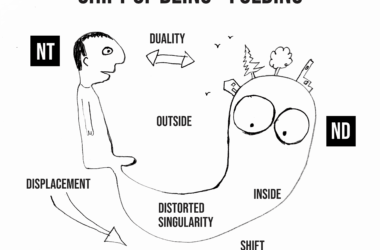
He describes relational capability in his texts as an ability for the associative and the symbolic, which means the merging of will, experience and object into an open identity. The integration of indimergence, emergence and submergence into the singular relationships between structures creates a reality in which patterns and structures develop without exact externally predetermined blueprints. In this context, it is implied that everything arises from self-similar relationship patterns, since in singularity everything is contained in everything and asymmetry makes emergence visible.
When Timothy Speed speaks of singularity, he is not referring to the physical term as used in astrophysics, but to a kind of radical non-conformity and subjective uniqueness in the context of economic and social systems. He sees in the conscious deviation from norms and the refusal to present oneself as a smooth, adapted “product” a possibility to initiate profound changes and innovations in society and in the economy. Speed lives a form of radical relational capability in which personal pain and sensitive perceptions flow into the creation of innovative, authentic values. This attitude challenges not only individuals but also companies to confront the complex and multifaceted aspects of being human instead of following mechanical conformism.
The texts refer to a critique of isolation and rigidity in systems and structures that should be capable of creating energy and liveliness and expressing themselves in harmony with other aspects and forces.
Furthermore, the importance of the dynamic development of concepts is emphasised, as in the statement that knowledge exists as structural information in all forms as soon as these are expressed as relationships and connections. The optimisation of human science is contrasted with the organic, imprecise nature which in its relations and effects is largely unconscious.
In the texts it becomes clear that relational capability is seen as the core of the emergence of structures and as a fundamental pattern of the universe. Relational capability creates and stabilises realities or enables their expansion, while the lack of it can lead to crises and conflicts.
“I therefore state in conclusion, and perhaps in summary, that the ‘Better’, meaning the ‘Good’ in capitalism, exists completely detached from real conditions. For it is not a reality, but a function. It is the function through which the devaluation of the human being continues to advance.” (Radical Worker p. 248)
The Everything–Nothing Paradox (ENP) according to Timothy Speed is a concept that questions the traditional view of objects and their significance in the world. Speed argues that in a world in which everything has become an object, paradoxically no objects exist anymore, because the “everything” thereby becomes the “nothing”. What is meant by this is the flattening, because the relationships behind the objects recede, and they thus degenerate into pure representations, into a simulacrum, similar to what Jean Baudrillard expressed. Speed sees everything and nothing as polar reflections in a state of universal absence of relationship, which reflects the non-object nature of the universe.
Speed’s approach suggests that objects and the nothing are nothing other than a feedback of themselves, which leads to the formation of polarities that differentiate all things into oppositional pairs such as good–evil or cold–warm. He claims that everything that exists is a representation of this fundamental polar reflection between everything and nothing, which takes place in an “empty” space that is actually a spacelessness and timelessness. Perhaps similar to Hegel’s thoughts on the concept of becoming.
The “nothing”, which is repeatedly reintegrated through processes such as submergence, indimergence and emergence, is not considered by Speed as a flaw in the understanding of the world, but as its foundation. He states that the object cannot ultimately explain the world, because reality is an open process from which the objects emerge, and not the other way around. Reality has a different relationship to the “nothing” than the object, and the gap-filled nature of the universe is not a lack of knowledge but the very nature of reality itself.
Speed’s theory calls for understanding the world not through objects but through experience, which is individual and cannot be relativised by objectivity. He argues that the permanent distinguishability between objects is guaranteed precisely by the gap and that comparability can never be achieved through objectivity without reducing the universe to an extreme degree. The ENP shows that the world cannot be constructed as an object because there is something that is simply not an object, and this non-object is what makes the relationship between the objects possible in the first place.
The concept of the MNO, developed by Timothy Speed, which stands for “Minimal Non-Object”, can be understood as a philosophical–physical principle that relates to the foundation of non-local phenomena. It represents a kind of minimal deviation from reality, which can be regarded as the basis for the binding of the world or as a higher-order principle of order. The MNO therefore stands for connections that do not exist in an immediate object-like sense and challenges conventional assumptions about references to reality.
In physics, for example, the MNO can contribute to the description of paradoxical states and outline the framework for an understanding of non-material patterns of order and integrated worlds, beyond conventional space–time relations. It questions classical particle research, because every object found in experiments such as those at CERN can only be recognised as a representation of the MNO, but never as the MNO itself.
Within society, politics and psychology, the MNO has a revolutionary significance, since it implies that reality and perception are altered through the inclusion of the non-object-like. The model of the MNO undermines established structures of dependency and demands a fundamental redefinition of social and political design by enabling paradoxes that are regarded as an essential prerequisite for humanity.
The “Reality Eye”, based on the analogy, could be a metaphorical description for the ability to perceive the reality expanded by the MNO — a state of consciousness that surpasses binary thinking in objects and grasps polarities in their connected singularity. This new perspective allows for a deepened understanding of reality and serves to fundamentally change the way we experience and understand the world.
It should be noted that the understanding of the MNO refers to the epistemological level in which the basic assumptions about the nature of reality are questioned and reconceptualised. To what extent the MNO acts concretely, for example in the political landscape, cannot be precisely deduced from this presentation, although the fundamental challenge to established power structures and dependency relations seems to be a central aspect. Overall, the concept of the MNO paves the way for an alternative understanding of freedom and individual as well as collective unfolding.
The concept of the “Reality Eye” refers to an expanded perception and interpretation of reality that goes beyond traditional objectivity and recognises the diversity and complexity of individual experiences and realities. It is a metaphorical concept that aims to overcome the limits of conventional perception and to develop a deeper understanding of the dynamics and interactions of different realities. The Reality Eye makes it possible to see reality as a legitimate living space that is intended in its diversity and should not be viewed as an error, but as an integral component of human experience and world-formation. It is about understanding reality not as a fixed object but as a dynamic phenomenon that knows no boundaries and takes place in the fractures between different axes. The Reality Eye acknowledges that reality happens in a world that ideally is not one world but many, and that this diversity contributes to a more realistic perception of the world.
The concept stands in contrast to a worldview shaped by objectivity and a static view of reality, and instead demands a recognition of subjectivity and individual experiences as part of reality. It rejects the idea that reality is only that which is seen as an object, and instead emphasises that the object itself is a simulation. The Reality Eye is therefore a plea for a pluralistic view of the world that honours structural relationships and individual freedom in shaping one’s own reality.
In this sense, the Reality Eye is a call to liberate oneself from dominant systems of order that legitimise themselves and suppress a polar opposite perspective by shrinking the gap between the poles and replacing it with causal myths. It is a tool for expanding the perceptive capacity of reality and recognising the diversity of lived realities that can enable humanity to become a more complex and freer form of life. The Reality Eye is therefore a key concept for the development of a new science and a new understanding of reality based on integrality and the recognition of the diversity of realities.
“Responsibility therefore only becomes concrete through the demand for immediate relational work, which overrides forms of ‘pseudo-responsibility’ such as obedience to unreflected rules or authorities.” (Radical Worker)
The action by Timothy Speed with Red Bull in 2010 was an attempt to redefine the relationship between companies and the individual by bringing the complex facets of human personality into the economy. As an artistic action he threatened to kill a bull in front of the Red Bull headquarters in Fuschl and used this as a forced dialogue with the company. In doing so, he triggered a subjective process that questioned the entrenched hierarchical corporate structures and led to internal tensions at Red Bull. Employees were confronted with the decision of how they should respond to Speed’s actions — humanly or functionally.
Speed intended that individuals are capable of reshaping and transforming corporations. He lived radical relational capability and created, through subjective communication, new living spaces that resisted commercial uniformity and emphasised the importance of authenticity and humanity in the economy. His approach was a counterbalance to simplification and efficiency increase, in order to preserve diversity and to demonstrate development potential in the economy, which also served as a basis for new markets.
Speed’s approach can be regarded as an innovative working model and as an intervention in corporate structures. He rejected traditional roles and, with his work, questioned conventional ideas of literature and art. By opposing simplification and efficiency increase and instead promoting progress and diversity, he became a positive disruptive factor in the system.
However, this role model also led to Speed’s economic failure and to social difficulties, yet in doing so he paved the way for a discussion about the role of the individual in the economy and society. With his novel Stieren des Weltdesigners and further actions he strongly advocated for self-determined life design and challenged complex, diverse orders.
Ultimately, Speed’s approach and his unusual commitment resonate in art as well as in society and the economy, as he raises essential questions about authenticity, human integrity and the values of capitalism.
Timothy Speed intervened in companies and authorities in order to promote an authentic shaping of society and new structures that integrate diversity and complexity instead of reducing them. He wanted to make management and the economy more innovative and closer to reality through personal, subjective and vulnerable approaches, in order to overcome automated structures and their negative side effects such as environmental destruction and social problems. His theory is based on the idea that through the participation of non-conforming and creative people in a system, the reality competence and developmental capacity of a society are strengthened. In practice this led to Speed, for example, attempting to reshape the company Red Bull by threatening to kill a bull in front of its headquarters in order to trigger a process in which the relationship between company and human being is renegotiated.
The particular value of these actions for society, science and research lies in the fact that Speed, through his interventions and his unconventional behaviour, creates the possibility to question and change existing structures. He exemplifies a radical relational capability with society and companies and shows that through subjective communication new living spaces and innovative value creation can arise. His work has high relevance and significance because in times in which individualism is displaced by fear, it promotes creative potentials and necessary processes of becoming conscious. Speed’s approaches make it possible to shape society no longer through rituals controlled by elites, but to explore and discuss it in individual processes.
His work defines a changed concept of responsibility in which the individual is responsible not only for the immediate duties of everyday life, but also for the world and the personal. He shows that the individual can break open the structure in the sense of humanity and capacity for innovation. Through his work and his life in extreme poverty Speed developed a new perspective on physics and demanded an expansion of the concept of reality in politics and the economy, in order to make the individual experience of people the basis of societal decisions. His resistance against corporations and governments is an act of creative creation and confronts them with the whole personality of the non-conforming individual.
Speed’s interventions concerning Hartz IV criticise the standardised definitions of poverty and the suffering of those affected, which is concealed by politics in a factual and bureaucratic language. Speed questioned the objective definition of the “correct” and demanded that the victims of Hartz IV should have the right to express their own experience of reality. The confrontation with the public prosecutor’s office and the Jobcenter showed how individuals are devalued by the system and are supposed to be stylised into cheap labour.
For science and society, this confrontation made it possible to work out that objective science and politics do not adequately reflect the reality of human beings. It became clear that the methodology of reification and the object-binding of modern science intervene deeply in our understanding of reality and that poverty is to be understood as a structural refusal of relationship by the system.
The consequences that should be drawn by politics and society from this include a departure from boundless objectivity and a turn toward a new understanding of the social and the creative, particularly in times of economic crises. A changed attitude should be developed toward a living experience of reality that is not relative, but that places lived and experienced relationship at the centre. This would also mean a change in methodology in economics, labour and poverty research that comes closer to open systems and integrates immediate experience into the description of living environments.
Politics and society should learn from these insights that reality may no longer be viewed only as a consequence of thinking and action, but as the actual living space that creates itself and transforms itself from within. A balance must be found that is not static or defined from the outside, but understands life itself as balance. Labour integration should replace the division of labour, and the structures in education, economy and politics should do justice to the experience of individuals and not merely represent status and conflicts.
In the Moderation State as an alternative model of democracy, the principle prevails: “above, pure representativeness and exemplary effect; below, the power distributed across the wider population as a factor of self-determination.” This means that in the Moderation State, politics should only exemplify the “ideal”, but not determine or even define it. Politics thus becomes the level of living out humane solutions, not of power, which therefore represents the reversal of the existing. The responses to the failure of politics in its attempt to live an ideal life then lead locally to individual, novel solutions as answers to it. Unlike in grassroots democracy, in which fundamental matters are decided at the base so that they apply to everyone, the Moderation State is a model in which implementation is always a local matter of free small units.
The concept of the Moderation State, as developed by Timothy Speed, differs from classical democracy through a stronger emphasis on individual responsibility, the integration of diversity and complexity, and the promotion of innovation and authenticity. In classical democracy the focus lies on voting and compliance with rules, whereas the Moderation State aims to shape society as an open developmental process in which lived experience and individual will are specified and integrated.
Speed’s approach aims to integrate the complexity of reality rather than reduce it, in order to shape closer to human beings and avoid automated structures that lead to negative side effects. He sees in the subjective, personal and vulnerable approach a possibility to enable true innovation and developmental capacity, since professionalised systems cut themselves off from the source of new insights.
The advantages of the Moderation State compared to classical democracy include:
Integration of diversity: The Moderation State seeks and integrates diversity instead of reducing it, which leads to structures that are closer to reality and more human-centred.
Promotion of authenticity: Through the emphasis on the personal and subjective, real innovative capacity is enabled, which is lost in over-professionalised systems.
Dynamic balance: Responsibility is not understood only as a duty towards everyday tasks, but also as the integration of inner and outer, personal and universally valid.
Conflict with existing structures: Individuals can break open existing structures in the sense of humanity and capacity for innovation.
The individual components of the Moderation State and their interaction:
Individual responsibility: The individual is responsible for integrating the world and the personal and bringing them into a dynamic balance.
Integration of reality: Society is to be shaped as an open developmental process in which lived experience and individual will are specified and integrated.
Authentic responsibility: Institutions, companies and the state are challenged toward authentic responsibility, which can lead to conflicts.
Integral axes: The recognition of integral axes makes it possible that each perspective is an extension of the other and that through integration a more complex reality is created.
The intention behind the Moderation State is to create a society that is closer to reality and to the human being, and that becomes more innovative and authentic through the integration of diversity and complexity. This is to be achieved through the recognition and working with the integral axes, which reflect a fluid and constantly changing reality. The Moderation State, as a model, attempts to solve the common problem of the abuse of power as well as of lobbying. For if above there is only exemplary effect, power as violence of the privileged against minorities is no longer possible in this form. More about this in the book Gesellschaft ohne Vertrauen.