
Operatoric Research Corpus
Studies in World-Formation
Section VI
Neurodivergent Rights, Law and Structural Violence
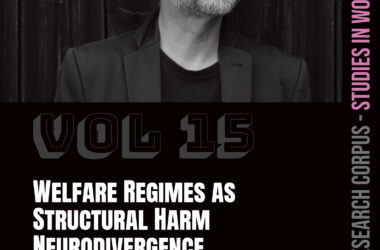
Volume 15
Welfare Regimes as Structural Harm Neurodivergence, Welfare Conditionality, and Institutional Violence
The present volume brings together four contributions that examine the structural relationship between neurodivergence, welfare-state institutions, and legal evaluative practices. The point of departure is the observation that modern welfare and legal systems operate on implicit assumptions of normality that presuppose neurotypical forms of communication, employment trajectories, conflict regulation, and social adaptation. For individuals whose modes of living and working diverge from these assumptions, systematic misinterpretations, institutional conflicts, and forms of structural vulnerability frequently arise.
The contributions analyze these dynamics from several complementary perspectives. A first focus concerns the interaction between neurodivergent persons and welfare-state institutions. The analyses show that administrative and legal procedures often interpret behaviors as deficits that are in fact expressions of neurodivergent perceptual and communicative styles. The resulting escalation dynamics therefore do not primarily stem from individual incapacity but from structural incompatibilities between neurodivergent ways of living and institutional expectation structures.
A second line of inquiry addresses the question of epistemic authority within legal contexts. The contributions investigate how statements made by neurodivergent individuals about their own life situations are frequently relativized or reinterpreted in administrative and judicial proceedings. This dynamic produces forms of epistemic disenfranchisement in which affected persons are no longer treated as reliable sources regarding their own needs and experiences.
A third analytical perspective focuses on the institutional organization of social security. Using central instruments of German social law—particularly the concept of the Bedarfsgemeinschaft—the contributions demonstrate how welfare systems organize subsistence security relationally and thereby generate dependency structures and conflict dynamics that are particularly burdensome for neurodivergent individuals as well as for non-standardized forms of work.
Taken together, the contributions argue that many conflicts between neurodivergent individuals and state institutions do not primarily arise from personal deficits but from structural mismatches between institutional systems and neurodivergent modes of existence. Under conditions of existential dependency, these mismatches can produce predictable forms of institutional harm. The volume therefore contributes to a critical analysis of welfare-state institutions from the perspective of neurodivergent experience and asks under which structural conditions systems of law, administration, and social security provide protection—and under which conditions they generate predictable forms of institutional harm.
Download PDF: https://zenodo.org/records/19002085
Speed, T. (2026). Welfare Regimes as Structural Harm Neurodivergence, Welfare Conditionality, and Institutional Violence (Studies in World-Formation, Vol. 15) (Version 1) [Computer software]. Zenodo. https://doi.org/10.5281/zenodo.19002085