


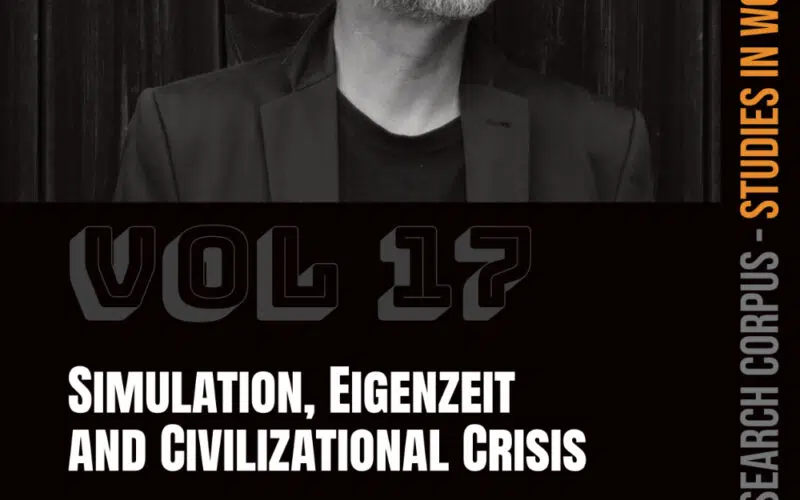
The present volume investigates the growing tension between emergent forms of world-binding and a society increasingly organizing reality through stabilization, simulation, administrative legibility, and functional reproducibility. Its point of departure is the observation that modern systems have developed enormous capacities for control, prediction, and technical organization, while simultaneously placing under increasing pressure precisely those conditions necessary for real emergence, embodied world-relation, long-term coherence, and open-ended processes of knowledge formation.
At the center of the volume lies the concept of operatoric world-binding. Cognition is not understood primarily as the processing of representations within already stabilized systems, but as an irreversible process of relational condensation through which world itself becomes bound, displaced, and reorganized. From this perspective, knowledge does not appear as static possession or mere information processing, but as something that can only emerge within Eigenzeit, movement, conflict, difference, and recursive stabilization.
The investigations assembled here bring together neurodivergent epistemology, labour critique, emergence theory, systems analysis, artistic research, and institutional field research. The volume argues that many phenomena currently interpreted as individual dysfunctions or psychological deficits — including work incapacity, communicative mismatch, overcomplexity, withdrawal, institutional escalation, or recursive conflict dynamics — may instead point toward deeper structural incompatibilities between different modes of societal world-organization.
Particular attention is given to forms of eigenzeit-bound cognition that remain only partially compatible with modern institutional regimes organized around standardization, reversibility, administrative control, and simulation-based productivity. Within this framework, neurodivergent forms of perception and cognition appear not merely as individual deviations, but potentially as contact zones in which suppressed conditions of emergence, irreversibility, and real world-formation become visible again.
The investigations draw upon long-term autoethnographic research conducted across labour systems, institutional conflicts, artistic practice, neurodivergent embodiment, and recursive theory production. The volume therefore deliberately operates within a boundary zone between personal experience, theoretical condensation, and structural analysis. Conflict, emotional intensity, institutional friction, overload, and destabilization are not treated merely as subjective disturbances external to knowledge production, but as part of the empirical field itself.
At the same time, the volume critiques an increasingly simulation-based organization of society in which reality becomes progressively managed through statistical models, algorithmic prediction, administrative abstraction, and functional controllability. The investigations propose that modern societies may thereby gradually lose the capacity to integrate real difference, open emergence, and forms of human existence that cannot be fully formatted into simulation-compatible structures. Contemporary conflicts surrounding neurodivergence, labour, psychological exhaustion, social fragmentation, institutional violence, and AI-driven governance therefore appear not as isolated crises, but as expressions of a deeper conflict between emergent world-formation and simulative stabilization.
The volume explicitly rejects both closed explanatory systems and universalizing claims. The concepts developed here function instead as heuristic operatoric structures intended to render visible tensions that appear to be intensifying within modern societies. At the center of the investigations lies the question of what happens when societies increasingly organize their stability through simulation while simultaneously losing the open, irreversible, and embodied processes from which real world-binding emerges in the first place.
Download: https://zenodo.org/records/20177396/files/Speed_2026_World-Binding-Vol_17_en.pdf?download=1